Douglas fir needles
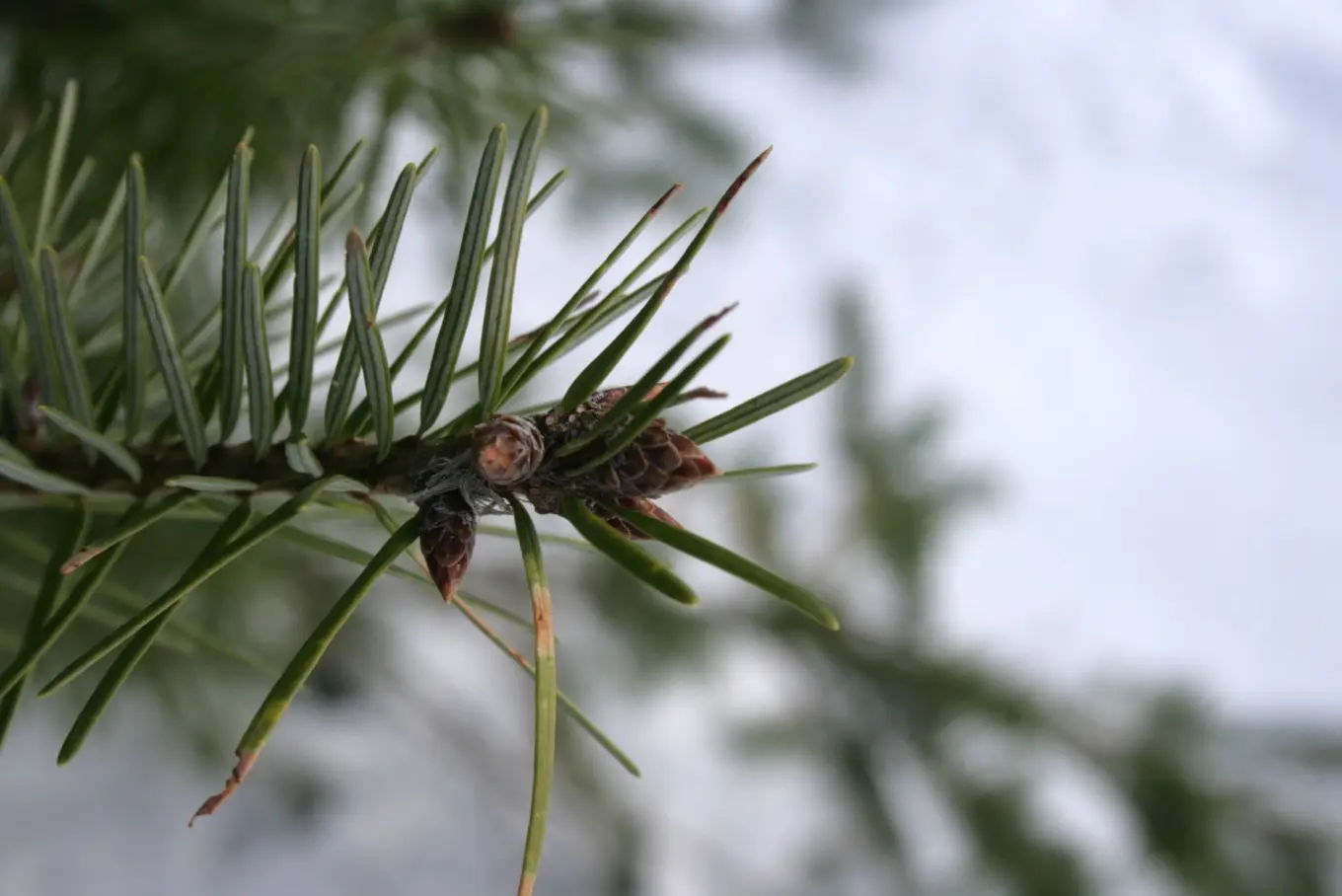
Soft, flat, about an inch long and growing all the way around the twig. The buds and cones settle any doubt.



Douglas fir (Pseudotsuga menziesii) isn’t a fir. True firs belong to the genus Abies. This tree has its own genus, and the name Pseudotsuga means false hemlock, which tells you how much trouble botanists had placing it. It is the most common conifer west of the Cascades in Oregon and Washington, and it has been planted widely in Britain for timber, so there is a fair chance one grows near you.
What the needles look like
- They are flat and soft, about an inch long (2 to 3 cm), with a tip that doesn’t prick.
- Each needle attaches to the twig on its own. Pines carry theirs in bundles of two to five.
- They stand out in all directions around the twig like a bottlebrush. On shaded lower branches they can flatten into two rows, which is when people get confused.
- The top is green to yellowish green. Turn one over and you’ll see two pale bands running its length.
- Crush one and it smells of citrus and resin. Nothing else on this page smells as good.
Check the buds
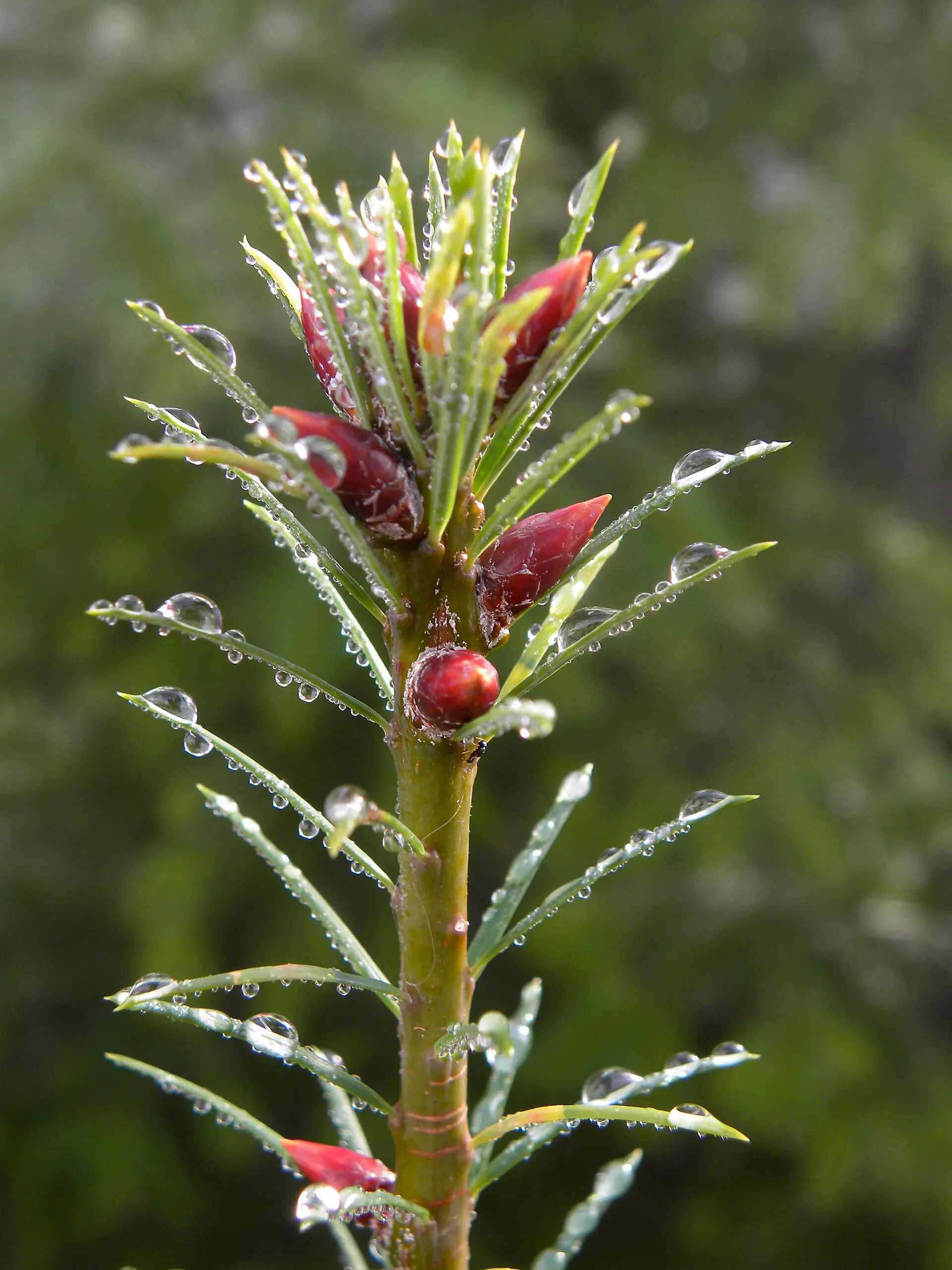
If needles were all you had to go on, mistakes would be easy. Look at the end of a twig. Douglas fir buds are long, sharply pointed and covered in reddish brown papery scales. True firs have blunt, rounded buds that are often sticky with resin, and hemlock buds are tiny and round. The Northwest Conifers guide makes the same point: when the needles lie flat and you start to doubt yourself, the buds settle it.
Then find a cone
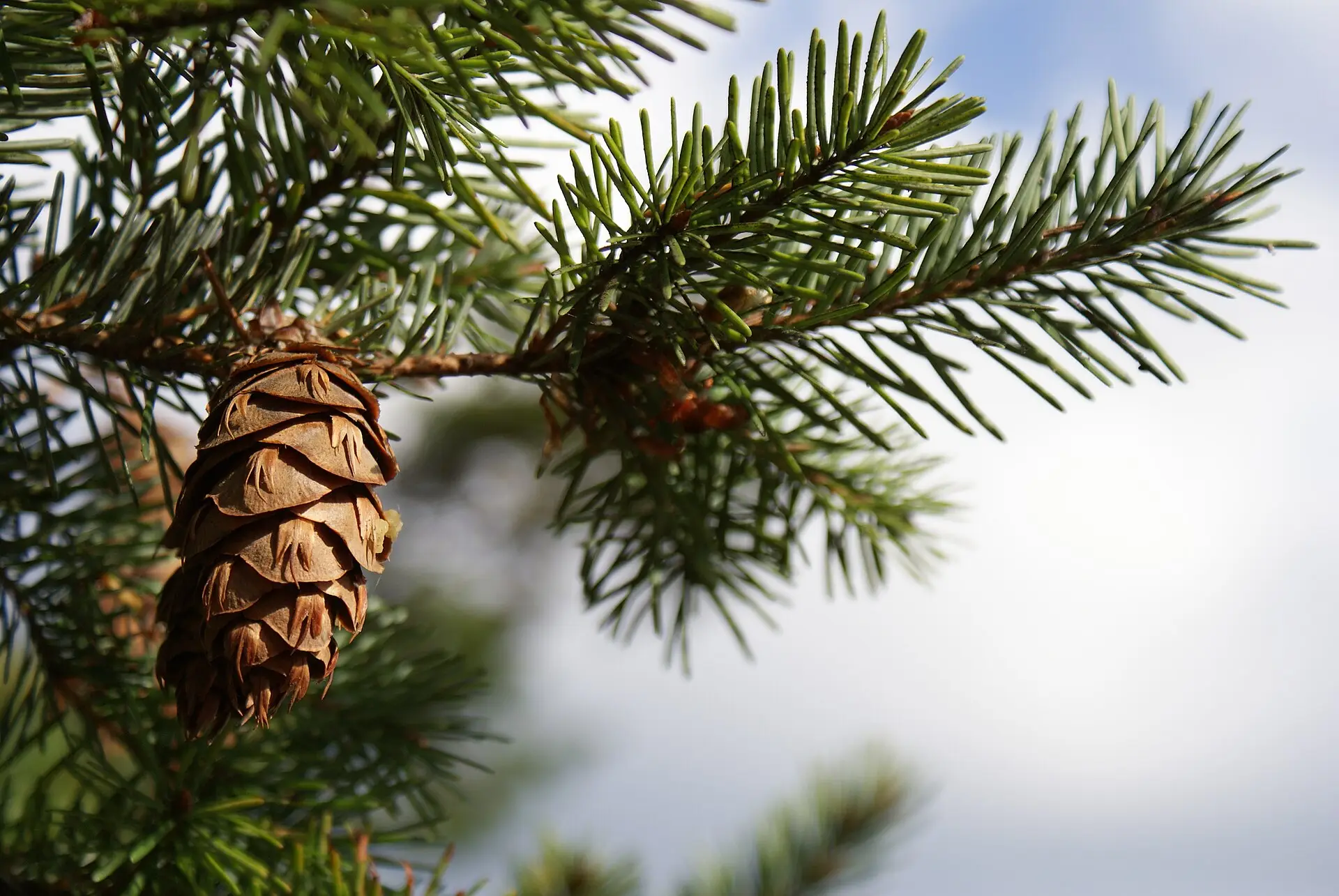
Douglas fir cones are 2 to 4 inches long and hang down from the branch. Poking out from between the scales are papery bracts with three points. The usual description is the back half of a mouse diving into the cone, two feet and a tail showing. No other conifer in the Pacific Northwest has them.
The cones fall whole, so you can usually find a few on the ground under a mature tree at any time of year. True fir cones stand upright and crumble apart on the branch, so you rarely find one intact.
Trees it gets confused with
Yew is the dangerous one. Its needles sit in two flat rows with no white bands underneath, and it never makes a woody cone. In autumn female trees carry red, berry-like cups, each around a single seed. Almost every part of a yew is poisonous. Our safety guide has a side-by-side table.
Western hemlock has short needles of obviously unequal lengths on the same twig, small round buds, and a top that droops over. Its cones are about an inch long. Hemlock the tree has nothing to do with poison hemlock, which is a weed in the carrot family.
Spruce needles are stiff, four-sided and sharp. Grab a branch: spruce hurts and Douglas fir doesn’t.
True firs such as grand fir have blunt buds and upright cones. Several of them make good tea in their own right, but learn them separately.
Are Douglas fir needles edible?
Yes. The young needles are eaten and brewed, and Wild Food UK rates the tree as the best of the edible conifers for flavor. People chop the needles into shortbread, steep them in syrup and vinegar, and grind them with salt. Most just make tea.
Edible doesn’t mean you’d want a bowl of them. They are a flavoring, like rosemary, and the woody stems are bitter. Pregnant women are advised to avoid conifer needle teas; the reasons are in the safety guide.
Can I use my Christmas tree?
Douglas fir is one of the common Christmas tree species, so people ask. We wouldn’t. Christmas trees are farmed, the farm may have sprayed them, and you have no way to check. Take needles from a tree whose history you know.
Fresh tips and old needles
The pale green growth that appears at the branch ends in spring is softer and more lemony than the older foliage. It is what the bought teas are made from. It has its own page: Douglas fir tips.
- Douglas fir . Northwest Conifers.
- Coast Douglas-fir . U.S. National Park Service.
- Douglas-fir (Pseudotsuga menziesii) . University of California Agriculture and Natural Resources.
- Pseudotsuga menziesii . North Carolina Extension Gardener Plant Toolbox.
- Douglas Fir . Wild Food UK.
- (Don't) Do the Yew . American College of Emergency Physicians, Toxicology Section, 2021.