Douglas fir tea side effects and safety
The tea itself has a clean record. The dangers are picking the wrong tree, picking a sprayed one, and pregnancy.


Nothing on this page is medical advice, and we aren’t doctors. It is a summary of what published sources say, with links at the bottom so you can check our reading of them.
Is Douglas fir tea safe?
For most healthy adults, in the amounts people normally drink, there is no known reason to think otherwise. Douglas fir doesn’t appear in Burrows and Tyrl’s Toxic Plants of North America, the standard reference, and people in the Pacific Northwest have been drinking needle tea for generations.
The librarians at the University of Washington’s Miller Library, who looked into this for the arboretum, add the obvious caution: a plant being absent from a list of toxic plants doesn’t prove it is risk free, and individuals react differently. We found no formal safety study of the tea. We’d call it a food with a long record and very little science.
The yew problem
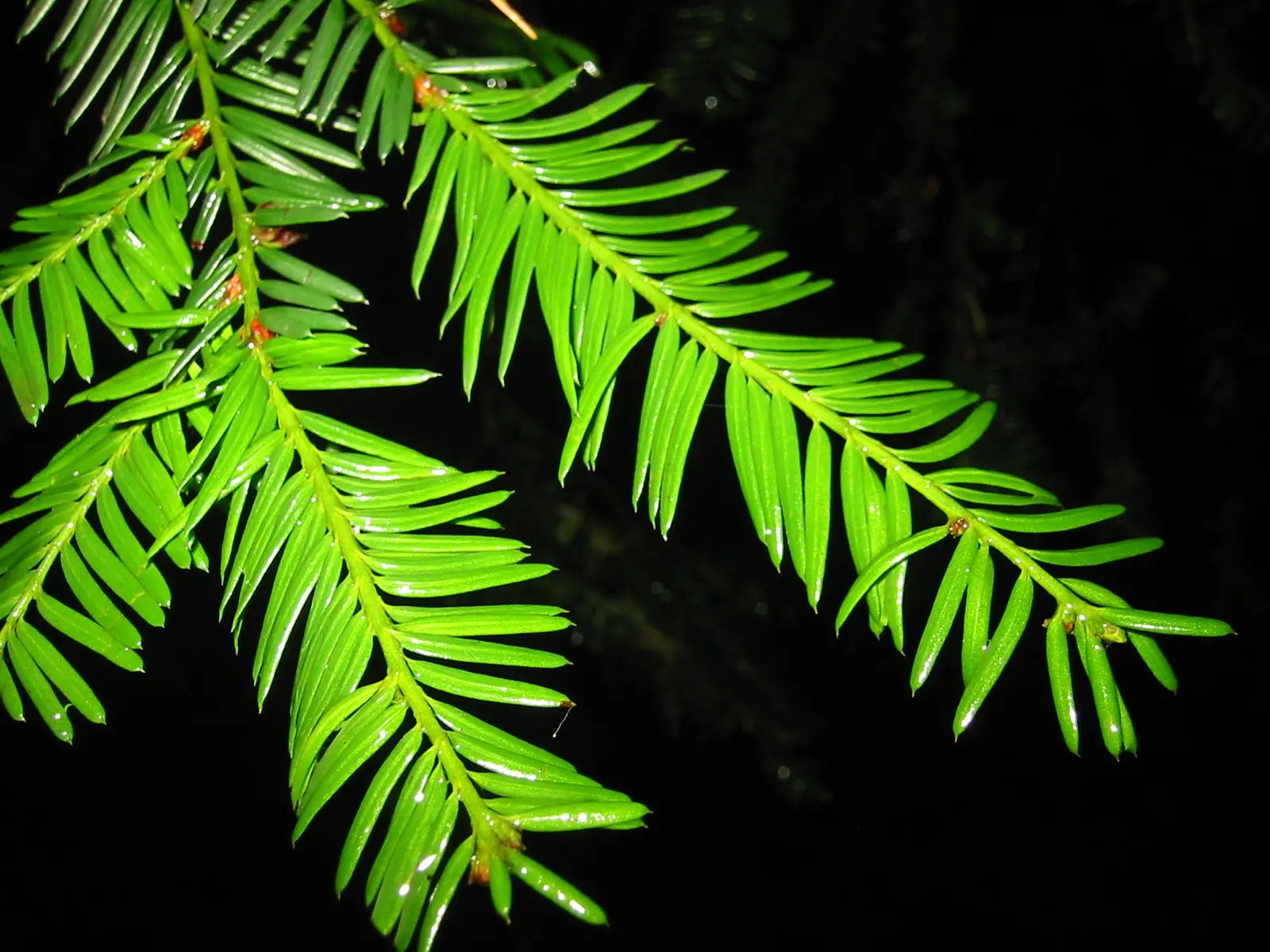
This is the risk that matters. Yews (Taxus species) are conifers with flat, dark green needles, and to someone who hasn’t looked closely they pass for a fir. Every part of a yew except the red flesh around the seed contains taxine alkaloids, which act on the heart. A toxicology review from the American College of Emergency Physicians puts the minimum lethal dose of yew leaves for a person at 0.6 to 1.3 g per kilogram of body weight, and there is no antidote.
Pacific yew grows in the same forests as Douglas fir. Veterinary toxicologists say it carries less taxine than English or Japanese yew, the kinds planted in gardens and hedges. That’s no reason to test it.
Here is how to tell them apart:
| Douglas fir | Yew | |
|---|---|---|
| Needles | All around the twig, like a bottlebrush | In two flat rows, like a comb |
| Underside | Two whitish bands | Paler green, no white bands |
| Buds | Pointed, reddish brown, papery | Small, green, rounded |
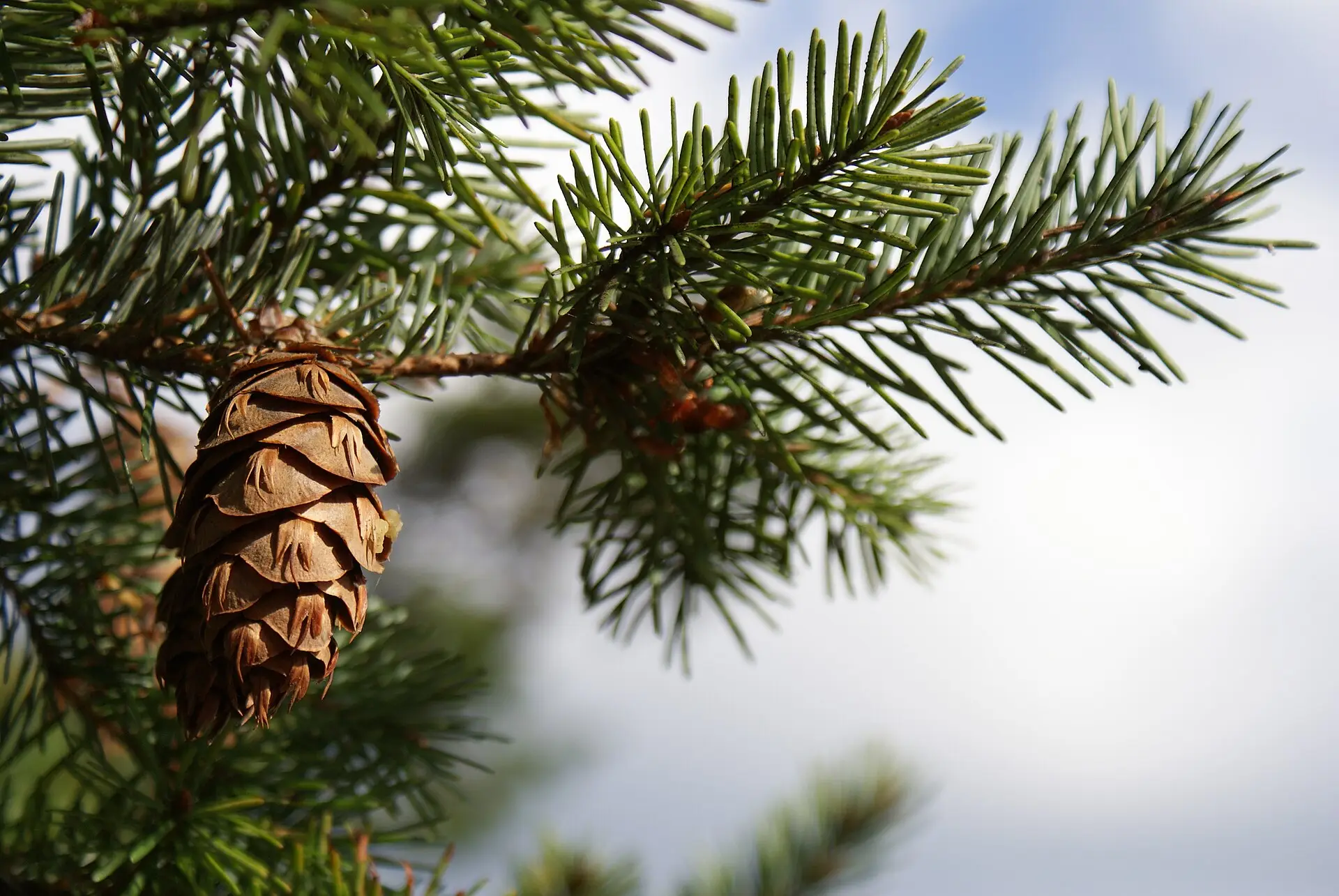
| Fruit | Hanging woody cones with three-pointed bracts | Single seeds in a red, berry-like cup |
| Crushed needle | Smells of citrus and resin | Very little smell |
If you can find a cone with those three-pointed bracts on the tree or under it, you have a Douglas fir. If you can’t find one, don’t pick. Our identification guide has more photos.
Pregnancy and breastfeeding
Skip it. The reasoning is indirect but worth knowing.
Ranchers have known for a century that cows grazing on ponderosa pine needles in late pregnancy abort their calves. The USDA traced it to a compound called isocupressic acid, and lists lodgepole pine, common juniper and Monterey cypress as other trees that contain it. Douglas fir isn’t on that list.
So the specific finding is about other species, in cattle, eating needles in bulk. But it is the reason nearly every source on conifer teas tells pregnant women to avoid them, and we found nothing showing Douglas fir tea to be safe in pregnancy either. RxList, summarizing the medical literature on fir generally, says not enough is known and to stay on the safe side. We agree.
Sprayed and polluted trees
A tree in a park, on a roadside or in someone’s yard may have been sprayed, and you usually can’t find out. The arboretum’s advice is not to gather from urban trees you don’t own. Christmas trees are a farmed crop and a poor choice for the same reason. Wash whatever you do pick.
Allergies and stomach upset
If conifer pollen or sap gives you trouble, go slowly. Try a few sips of a weak cup and wait a day before you have more. Stop if anything feels off.
Medications and medical conditions
We couldn’t find any documented drug interaction for Douglas fir tea. That mostly reflects how little it has been studied. If you take prescription medication or have a kidney or heart condition, ask your pharmacist before making it a daily habit.
How much is reasonable
There is no established dose, and WebMD says there isn’t enough reliable information to set one for Douglas fir products. We’d treat it like any other herbal tea, meaning a cup or two at normal strength. We wouldn’t drink it by the quart, and we wouldn’t give it to small children.
One firm rule: tea means needles in hot water. Douglas fir essential oil is a concentrated product for scent, and it shouldn’t go in a drink.
- Douglas Fir Tea: Ethnobotany and Health Benefits . Arboretum Foundation, Washington Park Arboretum Bulletin, spring 2026.
- (Don't) Do the Yew . American College of Emergency Physicians, Toxicology Section, 2021.
- Ponderosa Pine (Pinus ponderosa) . USDA Agricultural Research Service, Poisonous Plant Research.
- Fir: uses, side effects and precautions . RxList.
- Toxicology Brief: The dangers of yew ingestion . dvm360.