Douglas fir tips
A few weeks each spring the branch ends push out soft, lime green shoots. This is the part the tea companies sell.
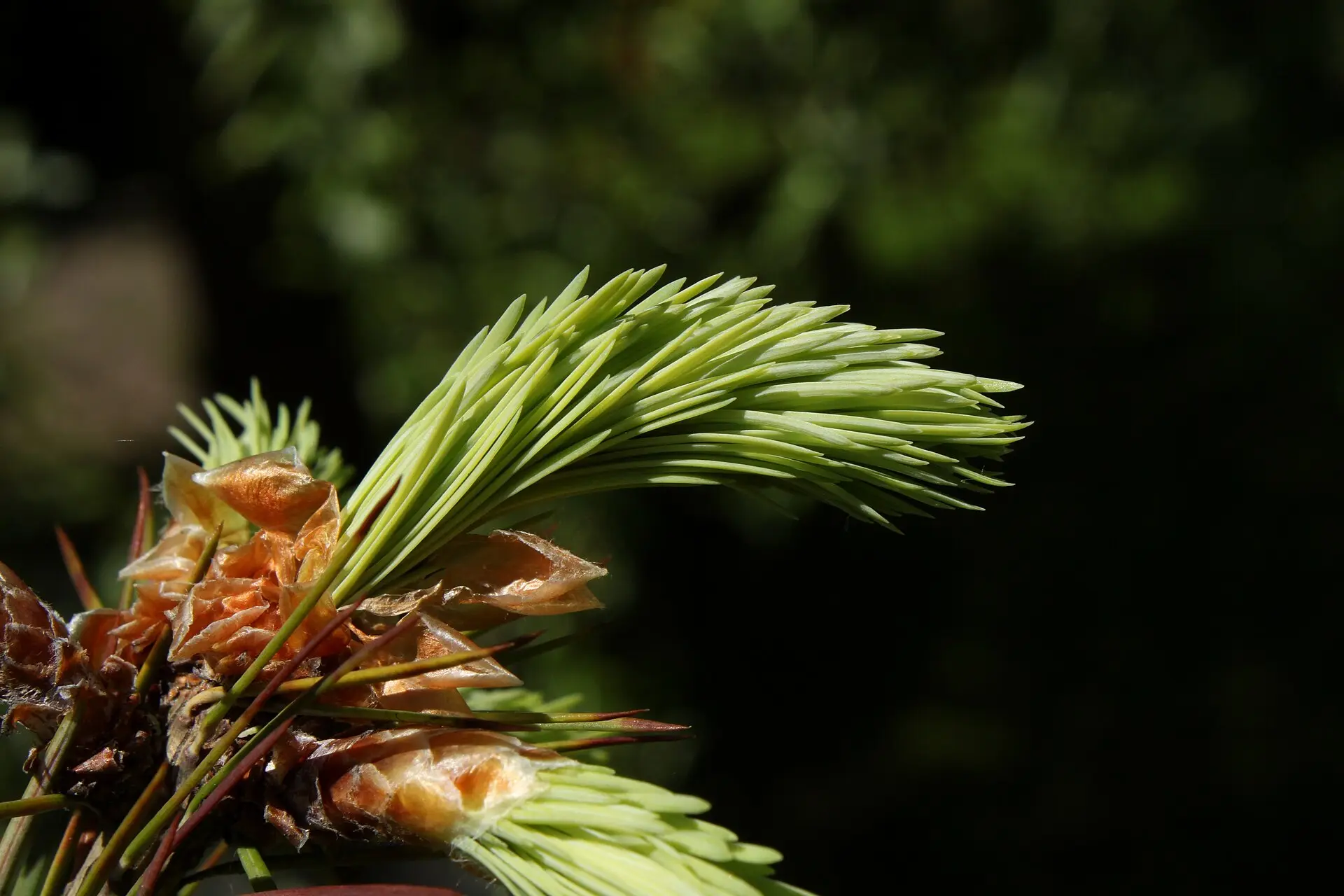

In spring the pointed buds at the end of each Douglas fir branch split their papery brown scales and a tuft of new needles pushes out. For a few weeks that growth is pale, soft and sharply lemony. Then it darkens, stiffens and becomes ordinary foliage. The soft stage is what people mean by Douglas fir tips, or spring tips.
The photo above shows the Rocky Mountain variety at that moment, with the bud scales still clinging on.
When they appear
It depends on where you are and how high. One Northern California forager gives March to June as the window. Low, warm sites come first and mountain trees run later, which means you can stretch the season by walking uphill.
You are looking for tips that are lime green against the darker needles behind them. If the new growth has gone the same dark green as the rest of the branch, you’ve missed it for this year. The older needles still make perfectly good tea, though.
How to pick without hurting the tree
Each tip is that twig’s growth for the year. Take it and the twig doesn’t extend until next spring. A big tree won’t notice a few handfuls, but a sapling will, so the usual forager’s rules apply here with some force:
- Never take the leader, the single shoot at the very top of a young tree. The tree’s shape depends on it.
- Pick a little from many branches and many trees. Don’t strip one.
- Leave small trees alone. Pick from the lower side branches of large ones.
Check who owns the land. Many public forests require a permit to collect plants even for personal use, and parks often forbid it outright. Avoid roadsides and anywhere that might have been sprayed.
And be certain of the tree. Our identification guide covers the buds and cones that separate Douglas fir from yew.
Tips aren’t the most nutritious part
You’ll often read that the new growth is the richest in vitamin C. The one study we found that measured Douglas fir through the season found the opposite: about 60 mg per 100 g of dried shoots in May against 275 mg in October. Pick tips for the flavor. We go through the numbers in the benefits article.
Drying and storing
Spread the tips in a single layer on a screen or a clean cloth, somewhere airy and out of direct sun, and turn them now and then until they are brittle. A dehydrator on its lowest setting does the same job faster.
Drying costs you vitamin C. Researchers working with Norway spruce tips, a relative in the pine family, found that freeze-dried material held four to seven times as much as tips dried in an ordinary herb dryer. Few people own a freeze dryer, so accept the loss or freeze some tips fresh in a bag.
Store dried tips in a jar with a tight lid, in a cupboard, away from light.
What to do with them
Tea first: a teaspoon of dried tips or a tablespoon of fresh ones per cup.
Beyond that, tips behave like a citrus-scented herb. Wild Food UK lists them blended into salt or sugar, steeped in vinegar, preserved in syrup and added to pesto. A simple syrup is the easy place to start.
Or buy them
Two companies sell dried Douglas fir spring tips as tea, one in bags and one loose. See the comparison.
- How to Make Douglas Fir Tea . NatureOutside.
- Douglas Fir . Wild Food UK.
- Determination of ascorbic acid in shoots from different coniferous species by HPLC . Radulescu et al., Farmacia, 2013, vol. 61, no. 6.
- Sprouts and Needles of Norway Spruce as Nordic Specialty: Consumer Acceptance, Stability of Nutrients, and Bioactivities during Storage . PubMed Central, PMC7570650.
- Douglas Fir Tea: Ethnobotany and Health Benefits . Arboretum Foundation, Washington Park Arboretum Bulletin, spring 2026.